There was a moment, somewhere around 2022, when every AI startup started looking the same.
Glow effects. Gradient orbs. Abstract 3D shapes floating in dark space. Motion-heavy hero sections that communicated one thing: we are the future. The aesthetic spread fast because it worked, briefly. It signaled innovation at a time when "AI-powered" was still a differentiator.
That moment is over.
According to MarketingProfs, only 49% of B2B brands feel truly unique to their buyers today. In AI, that number is likely worse. When every company uses the same visual vocabulary, the vocabulary stops meaning anything. Buyers stop seeing innovation and start seeing noise.
The shift happening now is from look innovative to look credible enough to buy from. Companies like Harvey are moving toward photography of real people, real offices, real workflows. The futurism is fading. What's replacing it is specificity, clarity, and the quiet confidence of a product that doesn't need to perform.
This list uses one filter above all others: which studios help AI startups build enterprise credibility, not just visual interest.
A few things to know before you read:
Every studio here has been evaluated on strategic clarity, tech relevance, and whether the work feels grounded rather than trend-chasing
Fit matters more than prestige - a studio can be excellent and still be wrong for your stage
The ranking is opinionated. That's the point.
How I ranked these studios
This isn't a directory. It's a shortlist built for one type of founder: Seed to Series A, with a strong product and a brand that hasn't caught up yet.
Four criteria drove the ranking:
Strategic clarity - does the studio help define what the company is before touching visuals, or does it jump straight to aesthetics?
Tech and AI relevance - does the portfolio show real experience with products that need to earn trust, not just attention?
Enterprise credibility - does the work feel like something a serious buyer would trust, or something a design community would upvote?
Stage fit - is the model and pace compatible with a founder who needs to move fast without losing control of the outcome?
Prestige didn't make the cut as a standalone criterion. A famous studio that specializes in consumer launches or brand theater is a bad fit for a B2B AI company trying to close its first enterprise contracts.
The studios below passed all four filters. Some more cleanly than others - and I'll say so.
1. Hex
hex.inc | Full-cycle creative studio for technology companies
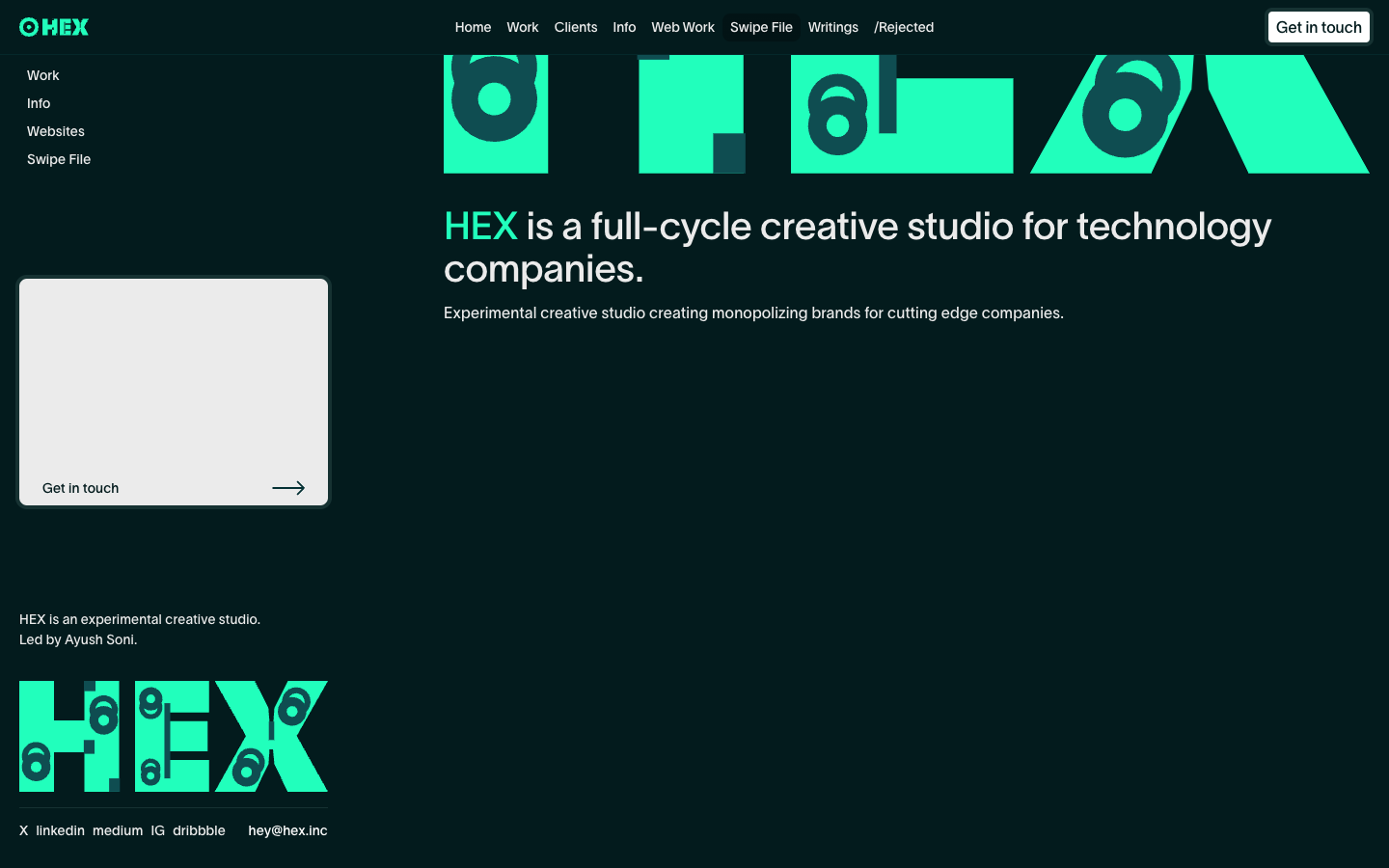
Hex describes itself as an "experimental creative studio" that designs "opinionated brands for opinionated people." That's not marketing copy - the portfolio backs it up.
Their AI client list is one of the most specific in this roundup: Exa (AI search, $85M Series B), Enterpret (AI customer intelligence, $25M Series A), Parahelp (AI customer success, $18M Series A), Sequence (AI-first revenue, $20M Series A), Sphere (AI tax engine, $21M Series A), and Adaptive (brand refresh ahead of OpenAI investment). These aren't edge cases. AI-native companies are a core part of what Hex does.
The work tends toward sharp, high-contrast visual systems with a strong typographic point of view. It reads as premium tech without defaulting to the glow-and-gradient playbook. That's harder to pull off than it sounds.
Full-cycle brand projects run 6-12 weeks at $15-30K - accessible for Seed-stage founders and competitive at Series A.
Strengths:
Proven AI startup portfolio across multiple categories
Visual identity that feels distinctive, not derivative
Strong execution across identity, web, and product messaging in one engagement
Worth checking:
The experimental aesthetic is a strong point of view - make sure it aligns with where your buyers sit
Better fit for companies that want to stand out visually, not just look credible
2. heartbeat
heartbeat.ua | Senior-only identity studio
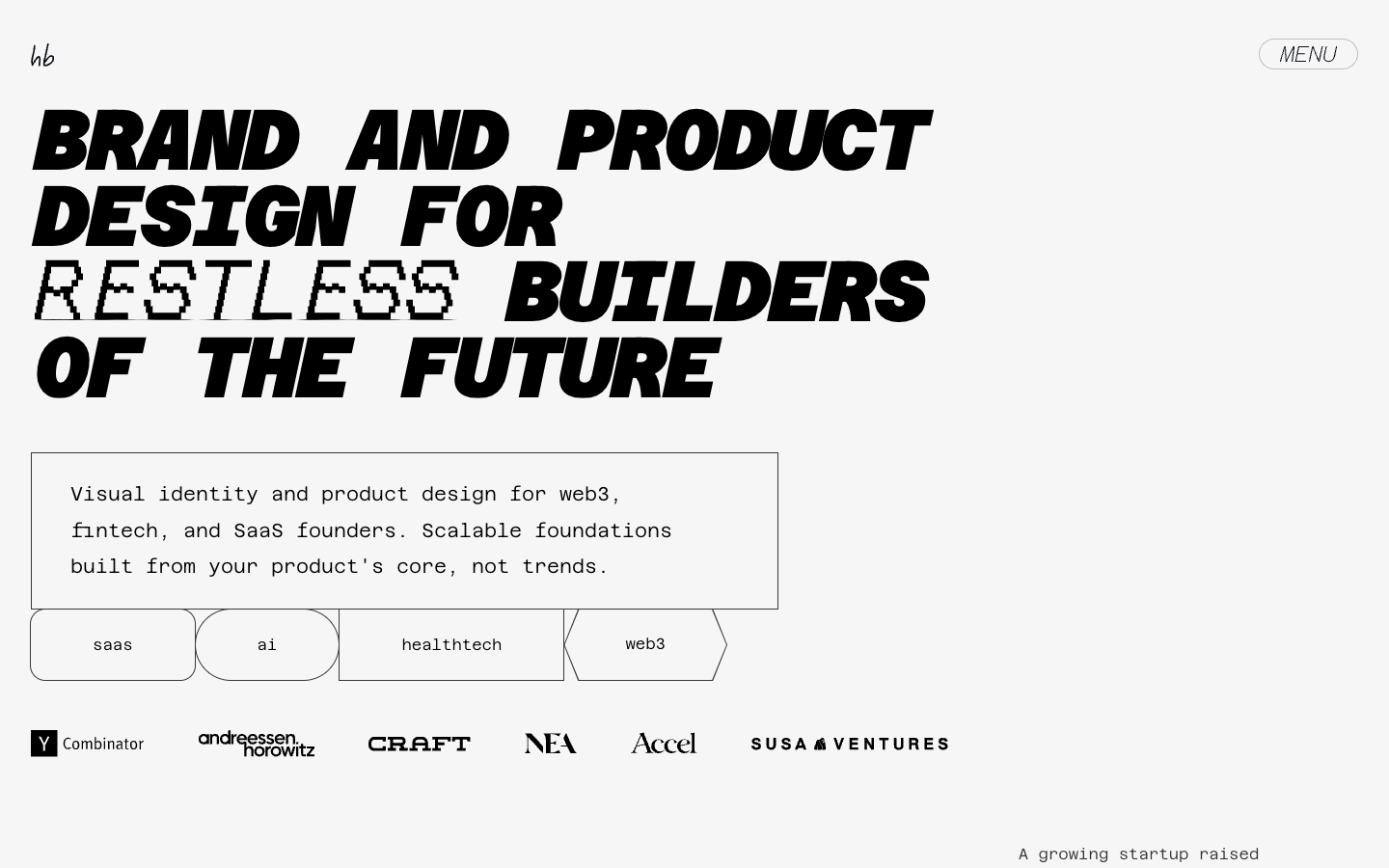
Most AI startups don't have a visual problem. They have a specificity problem. The brand looks generic because the positioning is generic - "AI-powered" repeated in different fonts across a dark background.
heartbeat's approach starts somewhere else. The work begins with what makes the product actually different: the specific problem it solves, the specific buyer it's for, the specific outcome it delivers. The identity comes from that. Not from a trend board.
That matters for AI founders because the studios that reach for futuristic aesthetics first tend to produce work that looks impressive for six months and embarrassing for three years.
Seven senior designers. Fifteen years working together. The companies they've worked with have raised over $1B combined. No account managers, no juniors interpreting the brief. The people on the call are the people doing the work.
Direct AI case experience includes Hyros, Corti, and Caplena - three different AI product categories, each requiring a brand system built around enterprise trust rather than novelty.
The founders who get the most out of a branding engagement are the ones who walk in knowing their superpower, who they're for, and who they're not for. That clarity doesn't come from the studio - but a good studio should pull it out of you if it isn't there yet.
Best fit if:
Your product is strong but your brand still looks like an MVP
You're approaching a fundraise, enterprise sales push, or high-profile launch
You need a system that your team can extend without breaking
You want senior judgment, not a junior team executing a template
3. Clay
clay.global | Full-service digital brand and product studio
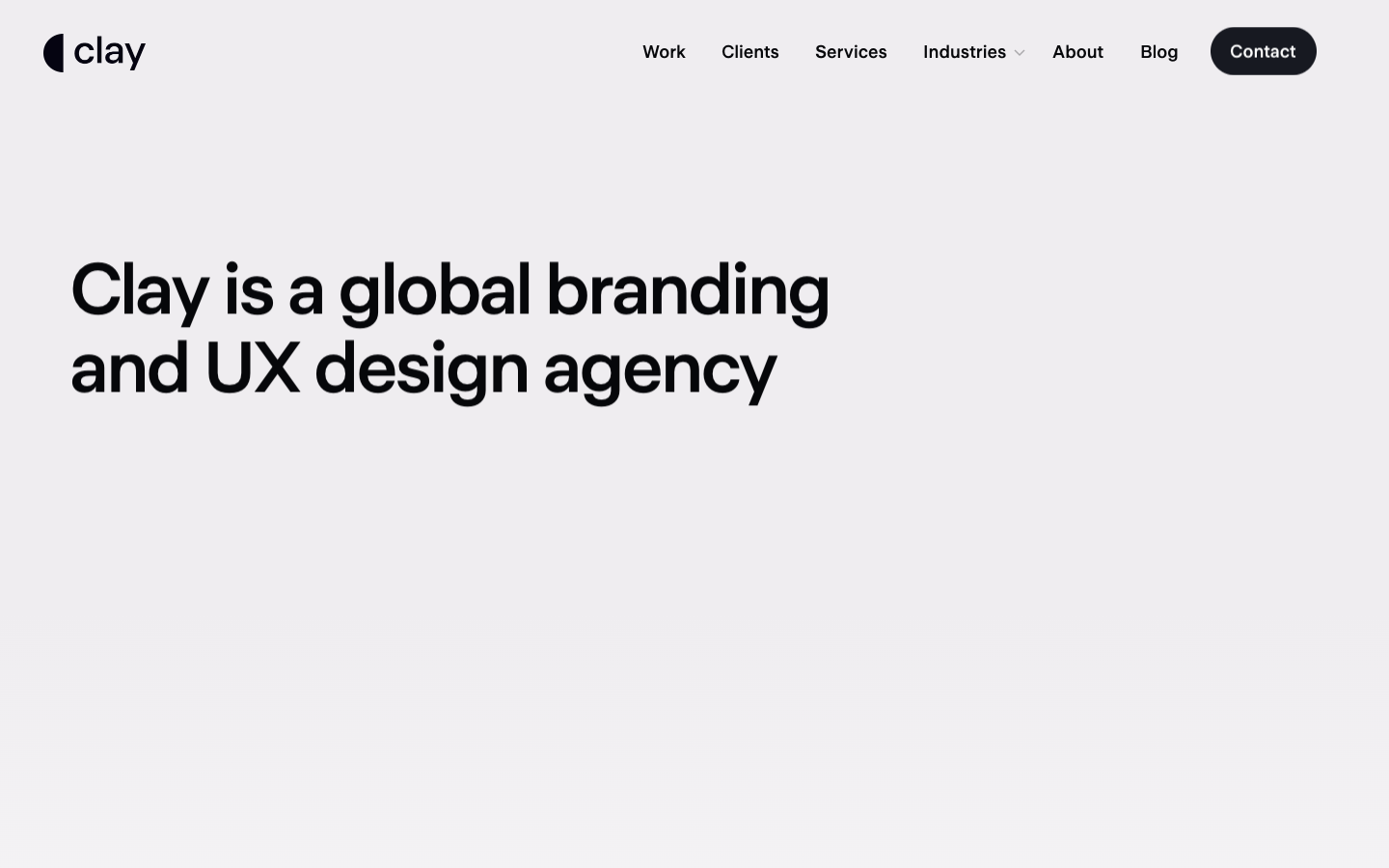
Clay sits at the intersection of brand identity and digital product design, and does both at a level that's hard to find elsewhere. The studio has built a reputation among tech companies for work that feels considered at every layer: typography, motion, product UI, marketing site. Nothing looks bolted on.
For an AI startup, that coherence matters. Enterprise buyers don't just evaluate your website - they evaluate your product UI, your onboarding flow, your sales deck. When those things feel disconnected, trust erodes before the demo ends.
Where Clay shines is execution quality. The work is polished, digitally mature, and tends to hold up well under scrutiny. It's the kind of output that makes investors comment on the product before you've opened your pitch.
Strengths:
Exceptional digital polish across brand and product touchpoints
Strong track record with tech companies at growth stage
Coherent visual systems that scale across web, product, and marketing
Worth checking:
Clay is at its best when a company already has strong positioning - if you're still figuring out what you are and who you're for, the execution quality won't compensate for the strategic gap
Likely a stronger fit for Series A and beyond, where the brand needs articulation rather than definition
Check current availability - studios at this level often have meaningful lead times
4. Ragged Edge
raggededge.com | Brand strategy and identity for challenger brands

Of all the studios on this list, Ragged Edge is the one I have the most respect for.
Not because of polish - though the work is sharp. Because of what they actually do: they build repositions that stick. The kind of brand shift where you look at the before and after and think "how did anyone take that company seriously before?" That's a different skill from execution quality. It requires understanding market context, competitive narrative, and what a company needs to stop saying as much as what it should start saying.
According to roundups on Pipedrive and Clutch, Ragged Edge is consistently cited as the go-to for startups undergoing significant pivots - companies that need a new market story, not just a new logo.
For AI companies, that's often the real problem. The product has evolved, the category has gotten crowded, and the original brand is anchoring the company to a story it's already outgrown.
Strengths:
Strongest strategic repositioning capability in this list
Work that creates category clarity, not just visual differentiation
Ideal for companies that need to shift market perception, not just update aesthetics
Worth checking:
Ragged Edge is best when the strategic problem is real - if you mainly need execution, there are faster options
The work is built around narrative first; teams that resist that process tend to get less from it
5. Red Antler
redantler.com | Brand studio for startups and growth-stage companies
Red Antler has built some of the most recognizable startup brands of the past decade. Casper, Hims, Allbirds - the list reads like a consumer brand hall of fame. That reputation is real and earned.
The question for an AI founder is whether that reputation translates to your context.
Red Antler excels at consumer storytelling: emotional narrative, category creation, brand launches that generate cultural momentum. That's a specific skill set, and it's genuinely valuable - for the right company.
For B2B AI startups, the fit requires more scrutiny. Enterprise buyers don't buy on emotional narrative. They buy on clarity, proof, and the sense that the company understands their problem better than anyone else. A brand built for consumer resonance can actually work against enterprise trust if it reads as style over substance.
Strengths:
Deep startup brand experience and a strong track record at launch
Excellent for companies with a consumer or prosumer component
Strong brand narrative capability when the story needs to travel beyond the product
Worth checking:
Consumer-brand DNA is a genuine consideration for pure B2B AI plays
If your buyers are procurement teams and enterprise CTOs rather than individual users, verify the portfolio has comparable work before committing
Likely strongest for AI companies with a consumer-facing layer or a brand that needs cultural presence, not just enterprise credibility
6. MetaLab
metalab.com | Product design and innovation studio
MetaLab's reputation was built on product. They designed Slack's original interface - that's the kind of reference that travels. The studio has since expanded into brand and innovation work, but the product-first instinct runs through everything they do.
For AI startups, that matters in a specific way. Trust in an AI product doesn't just live in the logo or the website - it lives in the interface. How the product responds, how it surfaces information, how it handles uncertainty. A brand that looks credible but leads to a product that feels rough destroys trust faster than a weak brand ever could.
MetaLab thinks about this holistically. If your biggest credibility gap is in the product experience rather than the brand identity, they may be the most relevant studio on this list.
Strengths:
Product-native thinking that extends brand credibility into the interface
Strong track record with tech companies where the product is the brand
Useful for founders who need brand and product design addressed together
Worth checking:
If your gap is purely brand identity and positioning - not product UX - a more identity-focused studio will likely serve you better
MetaLab's scope and model tend to suit companies with a more developed product that needs design elevation, rather than companies still defining what they are
Verify current focus areas; studios at this scale evolve their service mix over time
What AI founders should look for on the first call
The studio matters. But so does what you bring to the first conversation.
As MarTech's research on B2B buying behavior shows, AI is now embedded throughout the enterprise purchase process - which means buyers are evaluating your company with more information and higher scrutiny than ever. A generic brand is a liability at every stage of that journey.
The founders who get the most from a branding engagement are the ones who can answer three questions before the first call:
What is your actual superpower? Not "we use AI." What does your product do that no one else does, for a customer who has a specific problem?
Who are you for? A concrete buyer profile, not a market segment. The more specific, the better.
Who are you not for? This one matters as much as the others. Trying to be for everyone is why most AI brands end up saying nothing.
If your answer to the first question is "we're AI-driven" or "we're building the future of X," the branding will stay generic regardless of which studio you choose. The visual system is only as specific as the thinking behind it.
A good studio should help you sharpen those answers. But the raw material has to come from you.
The best AI branding won't look like AI branding for much longer
Think about what happened to "cloud-based." For a few years, it was a differentiator. Then every product was cloud-based, and the phrase stopped meaning anything. Now nobody says it. It's just assumed.
"AI-powered" is on the same trajectory. Within two years, the strongest AI brands won't look like AI brands at all - they'll look like strong companies. Specific, calm, credible. Built around a real product for a real buyer.
The studios that will serve AI founders best in that environment are the ones that already think this way. The ones building from product logic rather than aesthetic trend.
Here's a quick summary of where each studio in this list fits:
Studio | Best for | Primary strength |
|---|
heartbeat | Seed to Series A, AI or tech, inflection point | Product-rooted identity, senior-only execution |
Hex | Seed to Series A, wants visual distinctiveness | AI portfolio depth, opinionated execution |
Clay | Series A+, positioning already defined | Digital polish, brand-to-product coherence |
Ragged Edge | Any stage needing a narrative reset | Strategic repositioning, market story |
Red Antler | Consumer-facing or prosumer AI | Brand narrative, cultural presence |
MetaLab | Product-first companies | Interface credibility, UX-brand integration |
The right choice depends on where your gap actually is. But a 10-point improvement in brand experience correlates with 14% higher deal value - which means the cost of staying generic compounds every quarter you wait.
Looking for a practical framework? See how four AI startups solved the trust problem - from gaming AI to healthcare infrastructure: Branding for AI startups: how to turn technical depth into trust