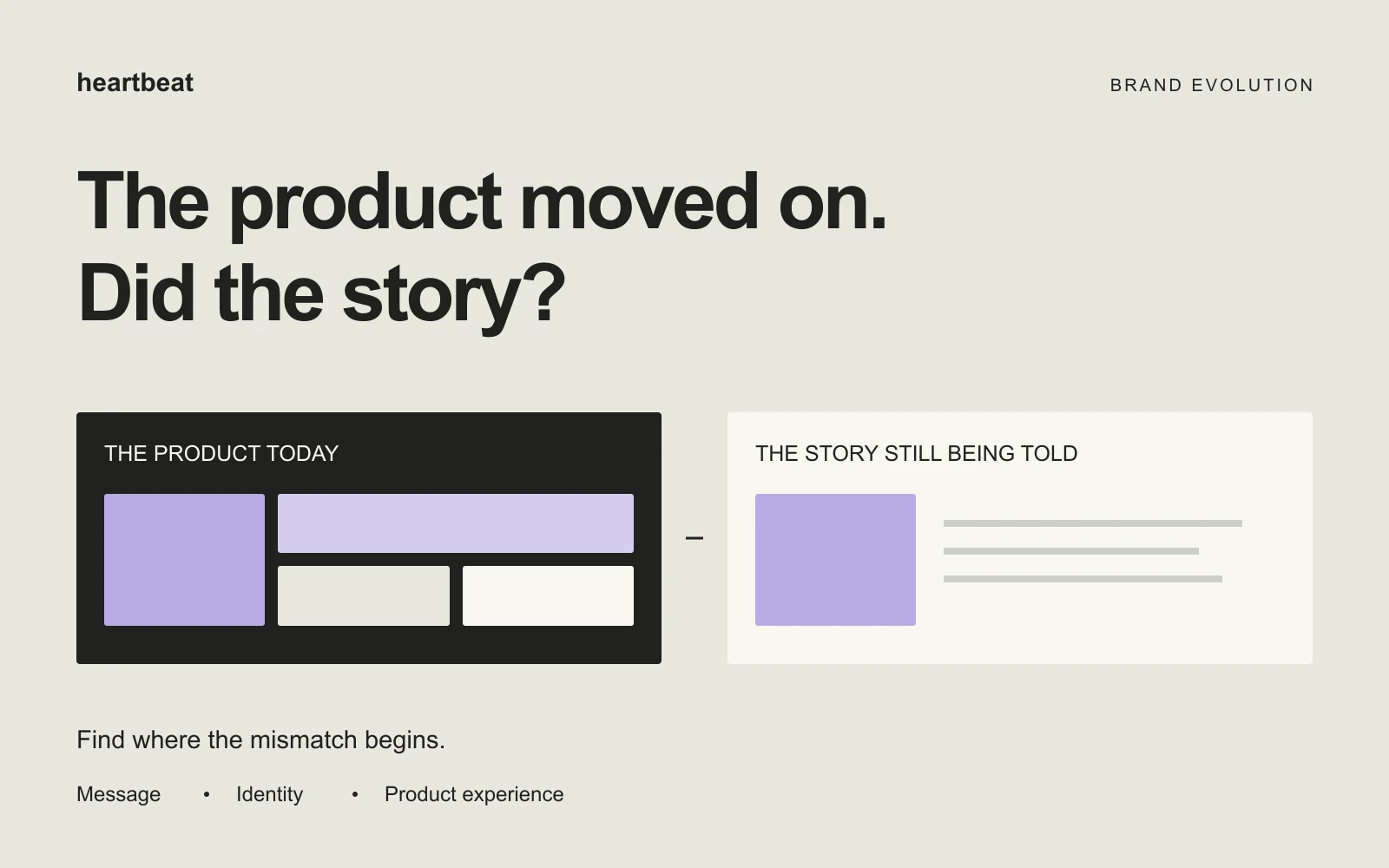
Your product now supports several workflows. The homepage still sells the first one. On calls, your team spends the opening minutes explaining that the company has moved on.
That mismatch deserves attention. It does not, by itself, tell you whether to rewrite the website, change the identity, or redesign the product interface. Start by finding what creates the wrong impression and what is still worth keeping.
For a B2B team, this means comparing the product customers use today with the explanation and experience they encounter before and after buying. The scope should follow the gap you find.
When the story no longer fits
A brand story can fall behind through ordinary product development. An initial feature becomes a platform. A tool bought by individual practitioners starts serving department heads. The team learns which customer problem matters most, but the website still uses the language of the original pitch.
Look for recurring mismatches:
Prospects expect a narrower product because the website leads with the original use case.
Sales keeps correcting the same misunderstanding about who the product serves.
A new buyer needs evidence or context that the current website does not provide.
The product covers several connected workflows, but the explanation makes them sound like unrelated features.
The name or visual character places the company in a category it has moved beyond.
Collect examples before commissioning a solution. Put the homepage beside a recent sales deck and a product walkthrough. Note where they describe different customers, problems, or capabilities. Ask the people handling sales and onboarding which explanations they keep having to add.
One confused prospect is a reason to investigate. A repeated misunderstanding tied to the same wording or visual cue gives you a more specific problem to work on.
Locate the gap before choosing the scope
The explanation no longer matches the product
Ask someone who resembles your intended buyer to read the website and explain what the product does, who it serves, and when they would use it. Compare their answer with the product you actually sell. Give them room to respond without correcting them along the way.
If the explanation is inaccurate but the name and visual identity still fit, the work may begin with positioning and messaging. That could mean choosing a clearer organizing idea, rewriting the homepage, and updating the sales materials that repeat the old story.
Adding every new feature to the page will not necessarily solve the problem. A platform needs a reason for its capabilities to belong together. The creative work is finding an explanation buyers can understand without sitting through your entire demo.
The identity carries an outdated impression
Someone may understand the words and still come away with the wrong impression of the company. The visual character might belong to an earlier audience, or a name might tie the product to a use case it has outgrown.
Be specific about that impression. "It feels old" is a weak brief. "It still looks like a tool for individual developers, while we now sell to operations teams" gives the work a direction to test.
A name does not have to describe the product literally. Nor does an identity update always require a new name. Identify which elements carry useful recognition, which create confusion, and which can develop further. The aim is a character that fits the company and its buyers, with enough room for the team to use it across the website, sales materials, and product.
The product experience has fallen behind
The marketing may describe the company accurately while the application feels inconsistent or becomes harder to use as features accumulate.
Separate visual issues from workflow issues. Inconsistent buttons and typography may call for a component system. Difficulty completing a task may require changes to navigation, information structure, or the flow itself. A polished interface can still leave the underlying task confusing.
Here, the scope may center on product design while retaining the existing brand direction. Test important workflows and identify the patterns the team needs to reuse. That gives designers and developers a basis for extending the product beyond the first set of redesigned screens.
These areas can overlap. Use the diagnosis to decide which decisions depend on others and which work can proceed together.
What different starting points look like in practice
Similar.ai: a changed product needed a new explanation
In his 2018 Clutch review, Similar.ai co-founder Robin Allenson described a product change that left the original website unable to explain the offer. The 2017-2018 engagement covered a new visual identity, logo, visual language, and website.
The engagement covered both the explanation and its visual expression.
Emhance: the company had outgrown its name
Emhance, formerly Sensemitter, is an emotion intelligence research platform for gaming studios. The company had raised investment and signed its first gaming studio clients before coming to heartbeat. Its name no longer matched where the product was headed.
We started with naming: Emhance brings together emotion and enhance. That decision gave the identity a new starting point. The wordmark, color system, and type pairing were developed for use across investor decks, studio pitches, and product UI, followed by the website.
The case shows a broader change grounded in the company's situation. The name, identity, and applications were developed together around the direction the business was taking. The investment was part of that context, not an outcome attributed to the rebrand.
RogerHR: modernizing the application
In a September 14, 2026 Clutch review, RogerHR co-founder Elias Mirza described a web app UI overhaul and a new component library for the HR platform's next version. Clients and the internal team had responded positively to the look and feel. The design was not yet in production at the review date.
The review supports an example of product interface work. It does not establish a full rebrand or post-launch business results.
GovEagle: making the direction usable after launch
A wider brand change also raises a practical question: how will the team keep using the direction once the initial work is delivered? Our article on AI-ready brand guidelines describes GovEagle's structured brand context and how it supports subsequent work. That is a useful next step when the direction is established and the team needs to apply it consistently.
Turn the diagnosis into a brief
Use the mismatch you have observed to define an initial scope. Keep open the decisions that still need investigation.
| What you have observed | Starting scope | Questions to settle |
|---|
| Buyers misunderstand the current offer | Positioning, website narrative, sales materials | Whether the existing name and identity can carry the revised story |
| Words explain the product, but the identity suggests an outdated category or audience | Identity development and its key applications | Which recognizable elements remain useful; whether naming is actually a problem |
| The application feels inconsistent or important tasks are difficult | Product design, priority workflows, reusable components | Whether the issue is visual, functional, or both |
| Several of these problems occur together | A connected scope with explicit dependencies | Which decisions must be settled first and which can develop together |
Buyers misunderstand the current offer
- Starting scope
- Positioning, website narrative, sales materials
- Questions to settle
- Whether the existing name and identity can carry the revised story
Words explain the product, but the identity suggests an outdated category or audience
- Starting scope
- Identity development and its key applications
- Questions to settle
- Which recognizable elements remain useful; whether naming is actually a problem
The application feels inconsistent or important tasks are difficult
- Starting scope
- Product design, priority workflows, reusable components
- Questions to settle
- Whether the issue is visual, functional, or both
Several of these problems occur together
- Starting scope
- A connected scope with explicit dependencies
- Questions to settle
- Which decisions must be settled first and which can develop together
A useful brief includes the product change, the buyer you need to reach, examples of the current mismatch, and the surfaces where it matters. Include what should survive: a recognizable symbol, a tone customers respond to, or a product pattern that already works.
Agree on how you will review the work before production begins. Can intended buyers explain the revised offer? Does the identity fit the context in which they encounter it? Can the internal team apply the direction to a new page or feature without inventing it again?
These checks will not prove that a rebrand caused revenue growth. They can show whether the work addresses the problem in the brief.
Where to start
Bring the current website, a product walkthrough, and a few examples of what buyers misunderstand. Those materials make the conversation about scope concrete.
If you want help deciding what to keep and what needs to change, discuss your product's next stage with heartbeat.